Hello, 

Thank you for joining us at the IUCN Leaders Forum 2024. 

A central theme of this year’s forum is innovation. From technology to new ways of thinking and financing conservation, innovation is key to forming inclusive approaches and creative solutions that respond to the escalating challenges impacting our planet. 

The three-day event kicked off today with sessions on harnessing technology for nature, how to finance successful conservation, and navigating the just energy transition. However, successful conservation needs to prioritise people. This was reflected in events on integrating Indigenous peoples’ knowledge with technology and science and ensuring innovative solutions from youth are supported – placing local communities at the centre of action for nature.   

We are pleased to share some of the highlights from the day, as well as what to look forward to on Wednesday 9 October. You can also watch recordings of many of the sessions on our virtual platform and app. 

Kind regards, 

The IUCN Leaders Forum Team 

Highlights from today
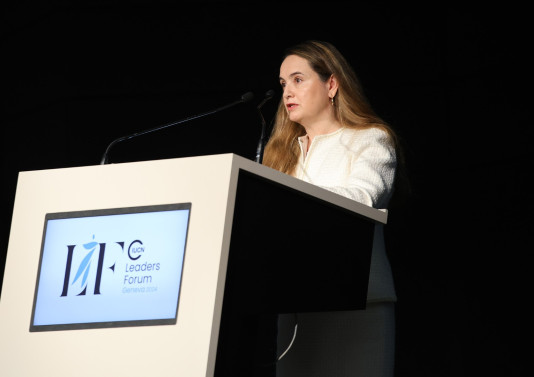
‘It’s your leadership that will light the path toward a future where humanity and nature thrive together’

Speaking during the Opening Ceremony, IUCN Director General Grethel Aguilar gave a powerful speech on the importance of engaging all stakeholders in the push for actions that realise a nature-positive future.  

Dr Aguilar set the groundwork for an inspiring and productive Leaders Forum 2024, which comes just a few weeks before CBD COP16, in Cali, Colombia, and Climate COP29, in Baku Azerbaijan, where critical decisions on realising global goals on biodiversity and climate will be made. 

IUCN Leaders Forum to harness innovative solutions to global challenges - News | IUCN
'Dialogue and speaking to local communities before innovations are introduced is key'

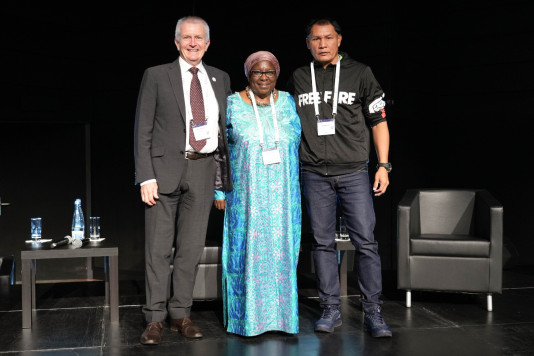
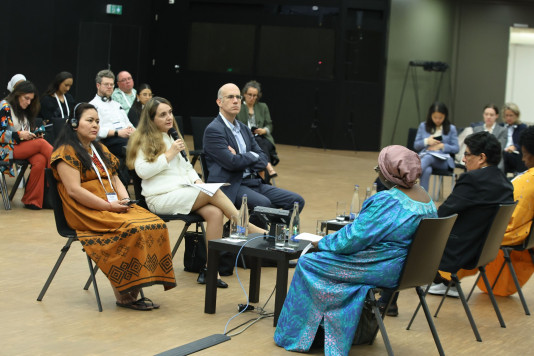
The first Morning Spotlight session featured an insightful conversation with Lucy Mulenkei, Masaai leader from Kenya, and Chief Tapi Yawalapiti from the Brazilian Amazon (pictured above, centre and right, with Stewart Maginnis, IUCN's Deputy Director General - Programme). They spoke about how technological innovations and traditional knowledge can complement each other if Indigenous knowledge is respected. 

Lucy Mulenkei said: “Traditional knowledge is what has kept us going, the Masaai continue to look after nature and be a part of it, as it is a part of us, a part of everything. The world is changing… It is no longer old times where we could follow one system. This is a challenge for communities in how to link new technologies to our own traditions. Putting this together is crucial.” 

She added: “Dialogue and speaking to communities before innovations are made is key – looking holistically so knowledge is recognised and respected.” 

Chief Tapi said that new technologies need to understand the “Indigenous vision” - how Indigenous people respect and interact with nature. He added that it is important Indigenous people are included and informed on how to use new technologies to address environmental problems. “We are the family of nature, we know the value and importance,” he said.

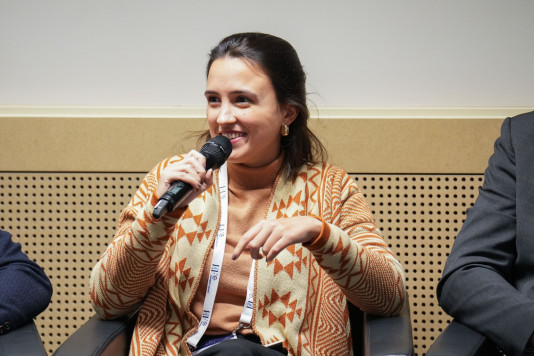
'We need to consider how the solutions we are creating can be more thoughtful of local communities'

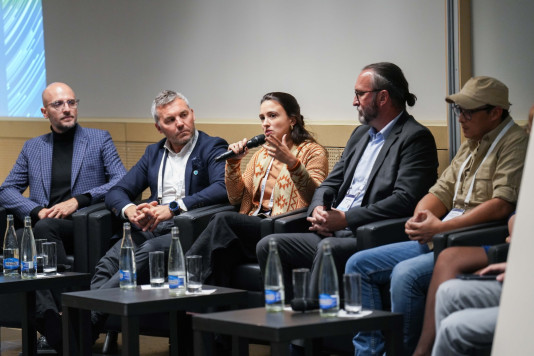
In the afternoon, participants packed into a session on technologies and innovations for conservation. Speakers gave examples of how their companies are using tech, including artificial intelligence, to address problems ranging from fighting invasive species to working with local communities to conserve degraded areas. Kenneth Fredriksen, Senior Vice-President, Europe Region for Huawei Technologies (pictured above), said that pilots of new tech solutions are important in “demonstrating the possibilities” but that the challenges come when scaling up.

David Gadsden, Director of Conservation Solutions at Esri, (pictured above) said realising the Global Biodiversity Framework targets offer “lots of opportunities for innovation”, in particular the 30X30 goal. However, the panel agreed that while there are opportunities for technology to problem solve, solutions must be locally appropriate and equitable.

Amanda Magalhães, Knowledge and Technology Manager at Climate Ventures, (pictured above) said: “We need to consider how the solutions we are creating can be more thoughtful of local communities.” 

Transformative partnerships

Working across sectors was an important theme of many of the afternoon sessions on day one. In the event, Finding the nexus equilibrium for nature, Indigenous peoples and climate harmony, IUCN Director General Grethel Aguilar shared examples of successful business models she has seen that have worked fairly with Indigenous communities, such as in fisheries. “Indigenous peoples need to be everywhere. Bring your knowledge and your challenges,” she said. 

Sébastien Soleille, Global Head of Energy Transition and Environment at BNP Paribas, said carbon credits are an example of positive projects as these bring funds from private companies to projects in the Global South, although these need to benefit nature and local communities long term. 

In the session on navigating the just energy transition, the panellists all agreed on the need to transition in a way that limits the impact on nature in line with 2030 – but that there is resistance from local communities, who must be integrated into planning. “We have to develop our energy infrastructure in a way that integrates local communities. The ‘Not In My Backyard’ mindset has spread, and it’s understandable,” Emilio Tejedor, Global Head of Environment at Iberdrola, said. “We are all part of the energy transition. “It is mandatory that all local populations understand why it’s necessary to build new infrastructures for transmission,” Eva Pagán Díaz, Chief Sustainability Officer at Redeia, added.

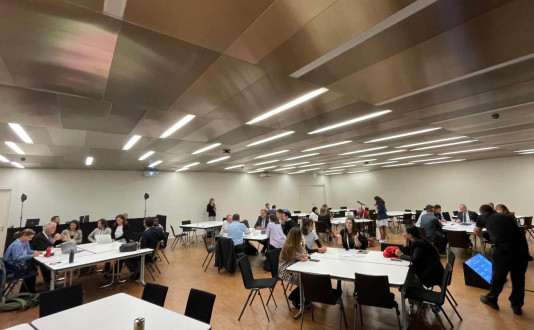
The end of the day saw a productive networking session on where participants were given an opportunity to build valuable connections and partnerships with like-minded professionals in the sector.

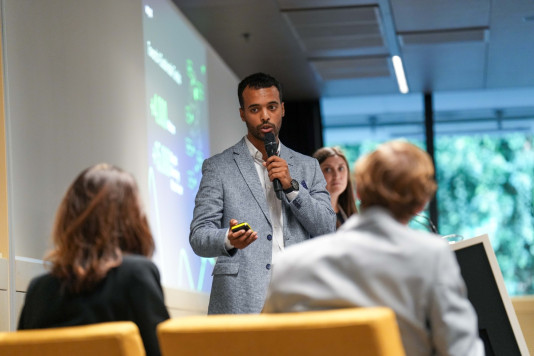
Some of the IUCN Leaders Forum Changemakers 2024, including Youssef Bouzariata from Tunisia, pitched their innovative solutions today to a panel of judges. More pitches are coming tomorrow!

Coming up on Wednesday

On the second day of the Leaders Forum 2024, there will be a firm focus on investment and closing the finance gap for nature and biodiversity, with important announcements on financing a circular plastics economy, and the release of IUCN’s flagship report on the interplay between agriculture and conservation. 

Investing in Nature: the path to "greening the world" 

9 October, 10.30 – 12.00 CEST, B - Plenary room 

Join us as we explore the investment case for financing nature and the latest and most promising solutions for scalable investments. 

Rethinking agriculture and conservation to secure the future of food 

9 October, 12.00 – 12.30 CEST, B - Plenary room 

This session will see the launch of a new IUCN Flagship Report on “Agriculture and Conservation” which examines the interactions, synergies and trade-offs between agriculture and conservation that sit at the heart of the Kunming-Montreal Global Biodiversity Framework.

Leveraging private philanthropy to reach the global goals for nature 

9 October, 14.00 - 15.30 CEST - Session Room 1 

With a $500+ billion-dollar gap in nature finance, private philanthropy’s role in investing in innovation and technology for nature has considerably increased. Enhance your understanding of how to leverage private funding for maximum environmental impact. 

Changemakers Pitch Event 

9 October, 17.30 CEST, Alpha & Beta - Session room 3 

Join part two of the Changemakers Pitch Event to hear from more inspiring young leaders and entrepreneurs as they pitch their innovative solutions to address some of the most complex nature and biodiversity challenges of our time. Following a short pitch presentation, each changemaker will respond to questions from a jury panel as well as the audience.

View the full programme of events, and speaker line-up
Thanks to our partners and supporters

HOST COUNTRY

ASSOCIATE PARTNERS

OFFICIAL SUPPORTERS

CONTENT PARTNERS

WITH THE SUPPORT OF

All photos by Building Bridges Hub / Anastasia Rod and Vasileios Mitsos, and IUCN.

Unsubscribe

IUCN Privacy Policy

IUCN Data Protection Policy

 Facebook  X / Twitter  Linkedin